
![IMG_4742-min[1]_edited.jpg](https://static.wixstatic.com/media/0e7e53_bd14bccc320f4f9d8ff9d014c7974054~mv2.jpg/v1/fill/w_135,h_90,al_c,q_80,usm_0.66_1.00_0.01,enc_avif,quality_auto/0e7e53_bd14bccc320f4f9d8ff9d014c7974054~mv2.jpg)
Buyer's Guide: Porsche 996 Carrera 3.4L
- 6 hours ago
- 4 min read
The Origins of a Controversial Revolution
It was more than two decades ago that the Porsche 996 Carrera 3.4, the fifth generation of the legendary 911, was born. To meet the profitability targets set by Stuttgart, the brand opted for an architecture shared with the 986 Boxster, particularly regarding the front end and running gear. Compliance with emissions standards necessitated a switch to water cooling, while production rates were significantly ramped up. Water cooling, components borrowed from its roadster sibling, large-scale industrialization... Could it still lay claim to the title of a true 911?
With prices having bottomed out a few years ago, the market is now awash with neglected, and sometimes abused, examples. Here are the key points to check before considering the purchase of a Porsche 996 Carrera 3.4.

What distinguishes the 996 from its predecessors
The Porsche 996 Carrera was the first 911 to truly break with the model line's established styling cues. In profile, the silhouette remains undeniably true to the brand's DNA, yet the front end, featuring the so-called "fried egg" headlights, marks a unique departure in the model's history. Compared to the 993 it replaced, the 996 grew by 14 cm in length and 4 cm in width, while sitting 5 mm lower and shedding approximately 50 kilograms.
Inside, purists had to come to terms with the loss of the dashboard featuring five separate gauges, which were consolidated into a single cluster behind the steering wheel. While the stylistic links to the Boxster frequently spark debate within the Porsche community, it must be acknowledged that the 996’s cabin boasts exemplary ergonomics: every control is positioned logically and intuitively.
An interior where budget constraints are evident.
However, the economic pressure imposed by Porsche management is evident in the choice of materials. In the 996, almost everything was an optional extra: leather upholstery, automatic climate control, PSM (stability control), and even the humble rear wiper. As for the glovebox, it was not even available as an option on early models.
Over the years, the upholstery in early 996s tends to show significant signs of aging, especially if the vehicle has not been kept under cover. Seats in good condition are a valuable indicator of the vehicle's overall maintenance. The soft-touch coating on the center console scratches easily, as do the handbrake and gear shift knob. Regarding electronics, dead pixels on the trip computer display are not uncommon and prove costly to fix. The latch mechanism for the rear console storage compartment occasionally breaks, and replacing it can easily run up a substantial bill.

A chassis that won over the general public.
For a sports car with a rear-mounted engine, the 996 boasts remarkably accessible handling dynamics. The combination of a front end derived from the Boxster and rear suspension geometry inherited from the 993 finally freed the 911 from its notoriously temperamental nature. While some purists might view this as a loss of edge, it was precisely this docile character that propelled the 996 to become the brand's best-selling model.
After more than two decades of use, suspension bushings are typically worn out. The braking system may also require an overhaul, depending on the mileage. While the car is not inherently fragile, a complete suspension refurbishment can easily cost several thousand euros, an expense to factor into your purchase budget. This work also presents an ideal opportunity to upgrade to the Porsche sports suspension or premium adjustable dampers, which can literally transform the car's driving dynamics.
One final point to check: the tires. The absence of the "N" homologation code indicates that the vehicle has been maintained on a budget, a scenario more common than one might think with cars that have had multiple previous owners.

The M96 engine: the Achilles' heel of the first series
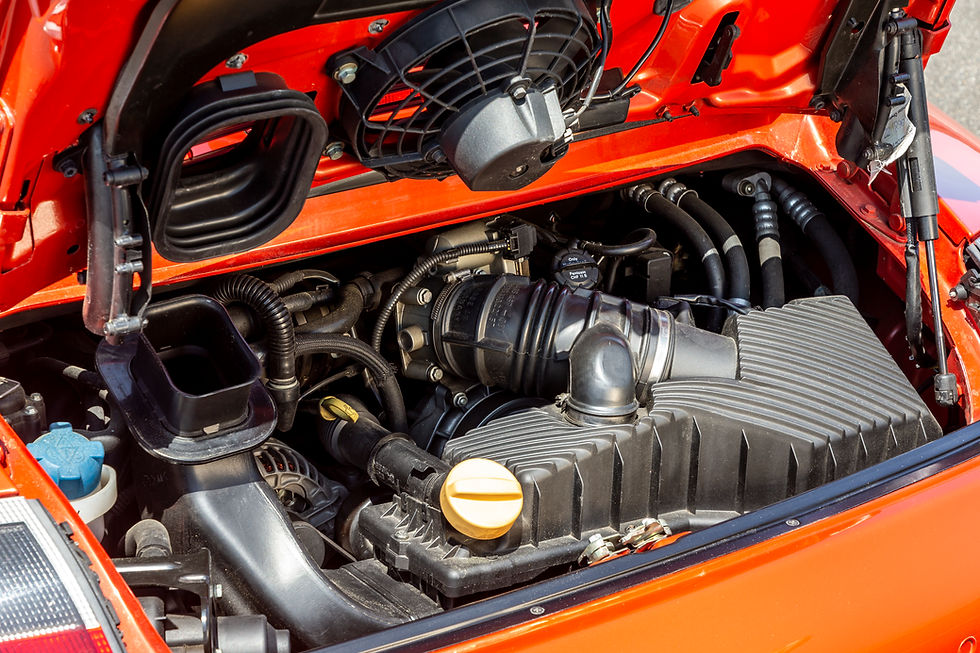
No serious 996 buying guide would fail to mention the weaknesses of the M96 engine. First, leaks from the rear main seal are common. Blue smoke upon startup indicates worn piston rings or, in severe cases, scored cylinder liners, a recurring issue with this engine block.
However, the most critical issue concerns the intermediate shaft (IMS) bearing; its seal can deteriorate, leading to catastrophic engine failure. Reliability estimates vary by source, but the failure rate is thought to be between 5% and 10% of all M96/97 engines produced. Preventive solutions exist, ranging from rigorous monitoring of oil quality to replacing the problematic bearing, an investment of around 2,000 euros.
The 996 clutch also has a reputation for being undersized; a stiff pedal is a sign of advanced wear. The manual transmission is also prone to synchronizer issues in second and third gears. The Tiptronic transmission, by contrast, suffers from no known major defects.
Front air intakes: a mandatory inspection point.
The two side air intakes in the front bumper house the cooling and air conditioning radiators. Daily use, combined with the accumulation of leaves and moisture, promotes oxidation of these heat exchangers and leads to leaks. Thorough cleaning at least twice a year is strongly recommended.
Air conditioning malfunctions often stem from these deteriorated radiators; replacing them can quickly run into the thousands of euros for parts alone. Before making an offer to purchase, it is therefore essential to put the vehicle on a lift and inspect these air intakes using an inspection light.
Verdict: a demanding acquisition, but a truly rewarding one.
The points raised in this guide illustrate the complexity of finding a truly sound example of the Porsche 996 Carrera 3.4. The cheapest car to buy almost invariably proves to be the most expensive in the long run. Cosmetic repairs can run up staggering bills, and mechanical work also requires a substantial budget.
However, those who put in the effort will be rewarded with an exceptional sports car whose modern driving dynamics easily belie its age. The 996 Carrera 3.4 sprints from 0 to 100 km/h in 5.2 seconds and boasts a top speed exceeding 280 km/h, all while offering the 911’s signature versatility at an unbeatable price point for the lineage. For anyone wishing to enter the world of the Porsche 911 under the best possible conditions, the 996 remains a particularly attractive entry point. So, is it a real 911? Absolutely.


